
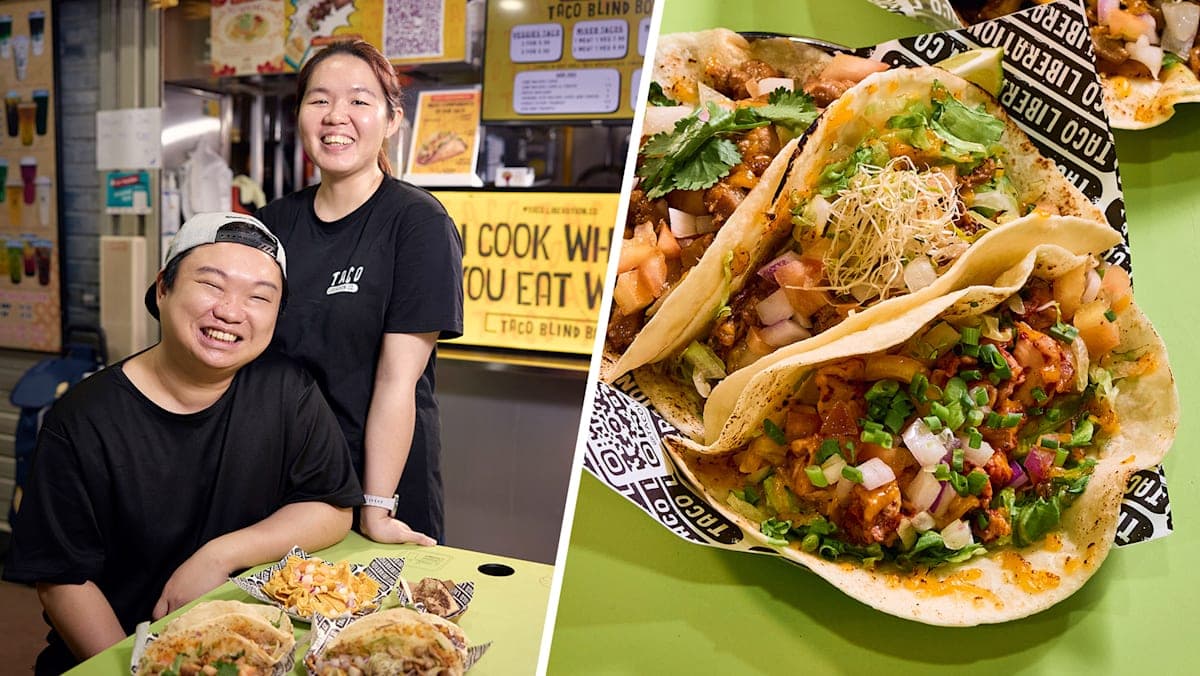
A new hawker stall at Amoy Street Food Centre is drawing attention not just for its fusion menu, but for the unconventional business model behind it. Taco Liberation Co, which opened on 6 December 2025, is run by Ong Ziqi and Veronica Liew — both graduates of the Culinary Institute of America in Singapore. Veronica spent five years at one-Michelin-starred Peranakan restaurant Candlenut before moving to Mondrian hotel as a pastry chef, while Ong accrued experience across navy catering, Dempsey Cookhouse, Yeast Side and BreadTalk.
The stall's concept is deliberately low-information. There is no printed menu, no food photography on display and no fixed daily offering — instead, a sign reads 'I cook what, you eat what.' Customers select a combination from a cai png-style price list (a two-meat, one-vegetable combo is priced at $8.90) without knowing which specific fillings they will receive. Proteins rotate weekly across three meat taco options and three vegetable alternatives, with batches sometimes changing sooner if supply runs out.
From a content and creator-economy perspective, the stall's design is structurally well-suited to social media documentation. The blind-box mechanic — where the outcome of a purchase is unknown until the moment of receipt — is a format that has driven significant short-form video engagement globally, most visibly through McDonald's character toy drops and collectible toy releases. Applying that mechanic to food creates an organic narrative loop: customers film what they received, compare results and return to try again, generating repeat-visit content with minimal marketing spend from the operator.
For food and lifestyle creators in Singapore, this kind of stall represents a content opportunity that is difficult to exhaust quickly. Because the menu changes weekly and portions vary by availability, no two visits produce identical content — a structural advantage over static hawker stalls where a single review video covers the entire offering indefinitely. Creators who document the experience early in the stall's lifecycle also benefit from first-mover positioning in search and recommendation algorithms, particularly on TikTok and Instagram Reels where novelty and local discovery content continue to perform strongly.
The culinary credentials of the founders add a layer of legitimacy that tends to amplify earned media coverage. Candlenut, under chef Malcolm Lee, holds one Michelin star and is widely cited in Singapore food media, meaning Veronica Liew's association with the restaurant functions as a trust signal for both press and social audiences. This dynamic — where a fine-dining background is used to contextualise a deliberately informal hawker concept — has become a recurring narrative in Singapore food content, and one that brands targeting food-adjacent audiences have increasingly identified as a credible entry point for collaboration.
The broader pattern here reflects a shift in how culinary talent moves through Singapore's hospitality sector. Formal restaurant training is being redirected into independent, lower-overhead hawker formats that are arguably more visible to a digitally active consumer base than mid-tier dining establishments. For the creator economy, this means the pipeline of compelling food-focused content subjects is expanding beyond celebrity chefs and restaurant openings into a grassroots tier that is geographically accessible, price-competitive and inherently shareable — conditions that tend to sustain consistent creator output over longer periods than a single review cycle.